




You already know what it feels like when your mind drifts even slightly away from the moment in front of you, because in combat there is no hiding from that shift, no buffer, no delay, and the instant your attention moves ahead into what might happen or falls back into what just happened, your timing changes, your reactions slow, and something that should feel instinctive suddenly feels just out of reach.
This is not a lack of skill, and it is not a question of preparation, because you have trained, you have drilled, and your body already knows what to do, yet in the moments that matter most there can be a subtle disconnect, a sense that you are thinking about the fight rather than being fully inside it, and that difference, small as it seems, is where performance begins to shift.
Here is the thing, combat is not decided by who knows more techniques or who has spent more hours training in a general sense, but by who is most present at the exact moment an exchange unfolds, because that is where timing exists, that is where openings appear, and that is where the fight is actually decided.
This is not about forcing focus or trying to concentrate harder, because the harder you try to hold onto the moment consciously, the more tension you create, and that tension is exactly what interferes with the natural flow of your reactions, so what you are really looking for is not more effort, but less interference.
You have already experienced what true presence feels like, in those sessions or moments where everything seems to slow down and your reactions happen without hesitation, where you are not predicting or analyzing but simply responding, and those moments are not random or lucky, they are glimpses of what happens when your subconscious is allowed to operate without being overridden.
The problem has never been your ability to perform at that level, because your body and your subconscious already contain the patterns required, but under pressure your conscious mind becomes more active, more involved, and more determined to control the situation, and in doing so it disrupts the very system that is designed to handle it.
This is not because your mind is working against you, but because it is trying to protect you, trying to anticipate outcomes and reduce uncertainty, yet in a combat environment where speed and responsiveness are everything, that attempt to predict and control becomes a limitation rather than an advantage.
Not because thinking is bad, but because thinking is too slow for what is required in those moments.
In striking, this often shows up as hesitation at the exact point an opening appears, where there is a fraction of a second spent checking or confirming before committing, and that fraction is enough to change the outcome of the exchange, while in grappling it appears as a pause during transitions, a moment where flow is interrupted by decision-making, and the opportunity is gone before it is acted on.
Across all martial arts, whether it is karate, Brazilian jiu-jitsu, taekwondo, or mixed martial arts, the same principle holds, because regardless of style or ruleset, the athlete who remains fully present in the moment has access to their true speed, their true timing, and their true ability to respond.
This is not about reacting faster through effort, but about removing the delay that comes from conscious interference, because the fighters who appear fast are not processing information more quickly in a deliberate sense, they are simply allowing their trained responses to occur without interruption.
That is the difference.
Not speed of thought, but absence of delay.
When you are present, your awareness expands rather than narrows, you begin to see and feel more of what is actually happening rather than what you expect to happen, and this shift changes everything about your performance, because now you are responding to reality rather than to prediction.
This is why presence is such a powerful advantage, because it does not rely on guessing correctly or anticipating perfectly, it relies on being able to respond instantly to whatever unfolds, and that is a far more reliable foundation under pressure.
The challenge is that presence cannot be forced in the moment, because anything you try to impose consciously under pressure tends to create more tension and more interference, so the real work has to happen before you ever step into that environment.
This is where subconscious training becomes essential, because presence is not a decision you make in the moment, it is a pattern that has been trained deeply enough that it becomes your default state under pressure.
Not because you remind yourself to be present, but because there is nothing in the way of it.
Visualization plays a key role here when it is done properly, not as a vague or passive exercise, but as a structured rehearsal where you repeatedly experience yourself responding in real time without hesitation, seeing the exchange clearly, feeling the timing accurately, and allowing your reactions to flow without interruption.
When this is done consistently, the brain begins to recognize that state as familiar, and familiarity is what the subconscious relies on when it decides how to respond under pressure, so instead of reverting to overthinking or hesitation, it begins to default to presence.
Breathing also supports this process, not as a technique you rely on mid-exchange, but as a way of conditioning your system to remain stable under pressure, because when your breathing is controlled your nervous system remains more balanced, and when it is balanced your awareness is less likely to collapse into narrow, reactive thinking.
This is not about slowing yourself down artificially, but about removing the internal noise that pulls you away from the moment, so that what remains is clarity, responsiveness, and flow.
Over time, this becomes something you trust, not because you have to think about it, but because you experience it repeatedly in training and competition, and that trust allows you to let go of the need to control every outcome.
That is when performance changes.
Not because you are trying harder, but because you are no longer getting in your own way.
The fighters who consistently perform at a high level are not doing something complicated in those moments, they are doing something very simple, they are fully there, fully engaged, and fully responsive to what is happening in front of them.
This is not a talent reserved for a few, and it is not something you either have or do not have, it is a trainable state that becomes more accessible the more you condition it at the subconscious level.
So as you continue your training, understand that the goal is not to think more clearly in the moment of action, but to remove the need to think at all in those critical fractions of time, because that is where your real performance lives.
Not in analysis, not in prediction, but in presence.
And when you are fully present, you are not reacting late, you are not hesitating, and you are not second-guessing, you are simply responding, and that is where fights are won.

🤼 Martial Arts Mental Training Programs - MAA, BJJ, karate & taekwondo - dedicated subconscious mind training programs for improvement in all areas of performance.
🎯 Personalized Sports Hypnosis Recording - A fully personalized session built around your specific mental and physical challenges, your competition response patterns, and the martial artist you are working to become.
🎯 New to Relaxation / Self-Hypnosis?
Our complementary 12 Minute Relaxation provides a guided recording perfect for starting out, or for anyone wanting quick light relaxation. More free downloads also on this page, for sleep etc.

🎧 Recommended Programs for This Topic

All Martial Arts Programs
Mental training for karate, BJJ, MMA, and taekwondo - built for the specific demands of your discipline.
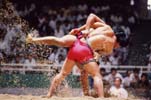
Wrestling
Enhance focus, confidence, and mental toughness with targeted wrestling mental training.

Boxing
Enhance focus, confidence, and mental toughness with targeted boxing mental training.

All Sports Hypnosis Programs
Discover our full collection of sports hypnosis products, with easy access to detailed information on each program.