



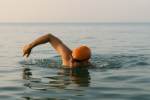
You have put the pool sessions in. The fitness is there - the aerobic base, the stroke efficiency, the ability to hold a pace across distance that you have built through months of consistent training. By the numbers, you are ready. And then you get in the open water and something happens that the numbers do not prepare you for.
It is harder. Significantly harder. Not in a way that can be explained by the slight temperature drop or the absence of lane ropes or the irregular surface chop. Harder in a way that seems to come from somewhere deeper - a fatigue and a difficulty that arrives earlier than your fitness should allow, a mental load that is simply not present in the pool, an experience of effort that is out of proportion to the pace you are swimming.
This experience is almost universal among swimmers transitioning from pool to open water, and among pool-trained swimmers racing in open water events. And the explanation for it is not what most people assume. It is not a fitness deficit. It is not a technique problem. It is a subconscious processing load - an invisible but very real mental effort that the open water environment imposes and that the pool never prepares you to carry.
What the Pool Does That Open Water Does Not
The swimming pool is, from a subconscious perspective, an extraordinarily safe and controlled environment. The bottom is visible and close. The walls are reachable. The lanes remove the need for navigation. The temperature is regulated within a comfortable range. The distance is measured in clear, countable lengths. Other swimmers are predictable, moving in defined directions within defined spaces. And help, if needed, is always within shouting distance.
In this environment, the subconscious threat assessment system is almost entirely quiet. There is nothing to monitor for danger. There is no navigation demand. There is no uncertainty about what the body is in contact with or how deep it goes. The swimmer's cognitive and emotional resources are available almost entirely for the physical task of swimming - and the physical task, practiced in these conditions thousands of times, is largely automated.
Open water removes almost every one of these conditions simultaneously. And the subconscious responds to their removal in the only way it knows how - by activating monitoring, vigilance, and threat assessment at a level that pool swimming never required.
"The open water swimmer is not just swimming. They are swimming while simultaneously managing a subconscious environmental threat assessment that is running continuously in the background, consuming cognitive and emotional resources that pool swimming never asked for."
The Hidden Processing Load
The specific demands that open water places on the subconscious processing system are worth understanding individually, because each one represents a genuine metabolic and cognitive cost that compounds across the duration of a swim:
Environmental monitoring. The subconscious is continuously scanning the open water environment for information relevant to safety - depth cues, surface changes, the presence and proximity of other swimmers, the quality of the water. This monitoring is largely automatic and largely below conscious awareness. But it is not free. It requires subconscious processing resources that are unavailable for everything else the swimmer is trying to manage.
Navigation demands. Open water swimming requires continuous navigation - sighting the course markers, maintaining a line, adjusting for current and drift, making tactical decisions about position relative to other swimmers. These demands are cognitively real and ongoing throughout the swim in a way that following a pool lane simply is not. The cognitive overhead of navigation is a genuine fatigue contributor that pool training never develops tolerance for.
Uncertainty processing. The subconscious is designed to be comfortable with the known and uncomfortable with the unknown. Pool swimming is almost entirely known - the distance, the environment, the conditions. Open water is substantially unknown - the current may change, conditions may deteriorate, visibility may reduce, the distance to the next marker may be misjudged. The continuous processing of uncertainty is a subconscious cost that accumulates invisibly but very really across the duration of a swim.
Thermoregulatory vigilance. Cold water requires the subconscious to maintain a continuous awareness of thermal state - monitoring for the signs of significant heat loss that would require a response. This vigilance, however subtle, is a background processing demand that the pool swimmer simply never experiences.
Why Fitness Alone Cannot Bridge the Gap
The swimming fitness built in the pool is genuine and it is valuable. It provides the aerobic capacity, the stroke efficiency, and the physical endurance that open water swimming requires. What it does not provide is any preparation for the subconscious processing load that the open water environment imposes.
Which means that a swimmer with excellent pool fitness arriving in open water is effectively carrying a significant additional load that their training has never prepared them for. Their physical engine is ready for the task. Their subconscious is not ready for the environment the task is being performed in. And the gap between those two states of readiness is what produces the experience of open water being disproportionately harder than the fitness should explain.
- Pool fitness prepares the physical engine
- Open water imposes a subconscious processing load the pool never builds tolerance for
- The processing load consumes resources that would otherwise be available for physical performance
- The swimmer performs below their fitness level because the fitness level was built in a different environment
- Bridging the gap requires building subconscious open water tolerance - not more pool fitness
The Anxiety Multiplier
Beyond the baseline processing load, many pool swimmers bring an additional subconscious element to open water that significantly amplifies its difficulty: genuine anxiety about the environment itself. Not necessarily dramatic fear - often simply a low-level unease about the depth, the visibility, the unfamiliarity, the absence of the safety cues that the pool provides so reliably.
This anxiety does not need to be intense to be costly. Even moderate levels of subconscious anxiety produce measurable effects on breathing pattern, muscle tension, and cognitive function that directly compromise swimming efficiency. The breathing becomes less controlled, increasing the oxygen cost of each stroke. The muscle tension increases, raising drag and reducing stroke fluidity. The cognitive function narrows, making navigation and pacing decisions more difficult under the conditions that demand them most.
The pool swimmer who arrives in open water with even moderate anxiety is essentially swimming with a physiological and cognitive handicap that has nothing to do with their fitness and everything to do with their subconscious relationship with the environment.
What Actually Bridges the Gap
The gap between pool performance and open water performance closes through two parallel processes - and only one of them happens at the pool.
The first is open water exposure - time spent in the environment that gradually builds the subconscious familiarity that reduces the novelty processing load. Each open water session that ends safely is a data point the subconscious files under manageable - and over time, the threat assessment of the environment genuinely reduces as the database of safe experiences accumulates.
The second, and the one that most swimmers underinvest in entirely, is deliberate subconscious mental training - working directly with the anxiety, the environmental threat assessment, and the monitoring vigilance at the level where they actually operate. This training does not replace open water exposure. But it dramatically accelerates the process of subconscious adaptation, reduces the anxiety contribution to the performance gap from the first session rather than after many, and builds the specific mental qualities - cold tolerance, uncertainty comfort, navigation focus - that open water demands and that pool training was never designed to provide.
The swimmer who has done this work does not find open water easier in the sense of less physically demanding. They find it easier in the sense of less mentally costly - which frees the physical capacity they actually have to express itself fully rather than being partially consumed by a subconscious processing load they were never trained to carry.
Your pool fitness is real. Open water is simply asking for something additional - something that lives in the mind rather than the body, and that responds to exactly the same quality of deliberate training.
 🏊 Open Water Swimming Hypnosis Program
Build the subconscious open water tolerance that pool training was never designed to develop - reducing the environmental processing load, dissolving the anxiety that is compromising your performance, and closing the gap between your pool fitness and your open water results.
Learn more about the Open Water Hypnosis Program →
The Freedom from Anxiety Program dissolves stress, worry and overwhelm at the deepest subconscious level with a powerful 4-track hypnosis system.
The Deep Focus & Concentration Program is a 5-track subconscious system designed to build deep work states, concentration, and sustained mental clarity for high-performance focus.
🎯 Need Something More Personalized?
While our pre-made programs are effective for most people, if your situation feels more complex, deeply embedded, or highly personal than what a general program can address, a tailored approach may offer a deeper level of support. Our Custom Hypnosis Recordings are personally designed for you, giving you the flexibility to target your specific goals and challenges through carefully engineered layered audio tracks, theta brainwave entrainment, binaural beats, and NeuroFrequency Programming™ - to guide the mind into deeply relaxed, highly receptive states where positive subconscious changes occur more naturally.
🎯 New to Relaxation / Self-Hypnosis?
Our complementary 12 Minute Relaxation provides a guided recording perfect for starting out, or for anyone wanting quick light relaxation. More free downloads also on this page, for sleep etc.

🎧 Recommended Programs for This Topic

Mind Training for Open Water Swimmers Program
Improve race focus, pacing control, and confidence in water with subconscious training designed for pool and open-water performance.

Triathlon Program
Strengthen mental endurance, transition focus, and race resilience across swim, bike, and run with integrated subconscious conditioning.

Distance Running
Enhance endurance, sharpen mental focus, and maintain steady pace under pressure with proven visualization techniques for runners.
Shop
See our entire selection of powerful hypnotic sports programs