



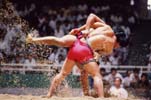
Wrestling is as honest a sport as exists. There is no team to share the weight with, no equipment to blame, no tactical formation to hide behind. It is you and one other person, in a defined space, for a defined period of time, and everything you have - physically, technically, and mentally - is on full display from the first whistle to the last. Nothing about who you are as a competitor stays hidden in a wrestling match.
This is what makes wrestling's mental demands so unique and so unforgiving. The physical preparation is obvious - the conditioning, the technique, the drilling of setups and counters until they are automatic. But the mental preparation that determines whether all of that physical work actually shows up when it matters is less understood, less consistently trained, and in many cases the decisive factor in matches where the physical gap between competitors is small.
Here is the thing: the mental game of wrestling begins long before the referee's whistle. It begins in the training room, in the way you respond to difficult sparring, in the beliefs your subconscious carries about what you are capable of against a particular level of opponent. It is present in the warmup, in the moment you see the bracket, in the walk to the mat. And the wrestler who understands this - and trains for it as deliberately as they train their single leg - has an advantage that technique alone cannot match.
"Two wrestlers of equal physical ability will produce unequal results every time - because no two wrestlers have equal mental preparation. And mental preparation is entirely trainable."
What the Subconscious Brings to the Mat
When you step onto the mat, your subconscious brings everything it has learned about competition, about this level of opponent, about what happens to you under pressure, and about who you are as a wrestler. It brings the accumulated weight of every hard training session, every match you have won convincingly, every match you have lost when you felt you should have won, and every moment where the physical and mental demands of wrestling asked more of you than you felt you had.
All of this information has been processed, categorised, and converted into automatic responses - patterns of behaviour, physiological reactions, and performance expectations that fire without conscious input the moment the competitive context is recognized. You do not choose how your subconscious responds to a high-level opponent. It responds the way it has been conditioned to respond, based on everything that has come before.
This is why two wrestlers with nearly identical physical profiles can perform so differently in competition. Their subconscious conditioning is different. One has been trained - deliberately or through accumulated positive experience - to respond to competitive pressure with activation and aggression. The other's subconscious reads the same pressure as threat, producing tightness, hesitation, and a level of performance that does not reflect their genuine capability.
The gap between your training room performance and your competition performance is almost always a subconscious gap. Closing it requires working at the level where it actually exists.
The Pre-Match Mind - Where Matches Are Decided
The period between weigh-ins and the first whistle is one of the most psychologically significant in all of sport - and one of the most consistently mismanaged. Wrestlers who spend this time in uncontrolled mental activity - replaying previous losses against similar opponents, worrying about weight and conditioning, imagining scenarios where things go wrong - arrive at the mat in a physiological state that is already working against them before contact has been made.
The stress response that uncontrolled anxiety produces in the hours before competition raises cortisol levels, increases muscle tension, and partially depletes the mental resources needed for clear decision-making and explosive execution on the mat. A wrestler who has spent two hours before their match in a state of anxious anticipation is a measurably different physical and mental performer than one who has spent those same two hours in a state of calm, focused preparation.
Elite wrestlers manage this period deliberately. Not by suppressing the competitive arousal - that arousal is fuel, and eliminating it would remove a genuine performance advantage. But by keeping it in the range that produces optimal performance rather than allowing it to escalate into the anxiety range that impairs it. This is a trainable skill, and it is one of the highest-leverage mental performance interventions available to any wrestler.
Aggression, Confidence, and the Attacking Mindset
Wrestling rewards aggression. Not reckless aggression - the kind that creates openings for counters - but the controlled, confident aggression of a wrestler who initiates action, dictates the pace, and makes the match happen on their terms rather than reacting to what their opponent brings.
This attacking mindset is partly technical - knowing when and how to shoot, when to tie up, when to create scrambles. But it is primarily subconscious. The wrestler who attacks with confidence does so because their subconscious expects the attack to produce a result. The wrestler who hesitates, who shoots tentatively, who waits for the perfect moment that never quite arrives - their subconscious is managing risk rather than seeking opportunity. And in wrestling, risk management produces losses.
Building the attacking mindset through subconscious training means conditioning the automatic response to a competitive situation as one of aggressive opportunity-seeking rather than cautious threat-management. It means installing, at a level below conscious thought, the expectation that initiating produces results - and that hesitation is more dangerous than commitment.
- Visualization of successful attacks - vivid rehearsal of setups, shots, and finishes that encodes the experience of aggressive, confident execution at the subconscious level before competition.
- Confidence conditioning - building the subconscious expectation of winning exchanges, not as arrogance but as the automatic assumption that your technique will work when you commit to it fully.
- Hesitation pattern interruption - identifying and directly addressing the subconscious triggers that produce hesitation on the mat, replacing the wait-and-see response with the commit-and-execute response that wrestling rewards.
Handling Adversity - When the Match Turns Against You
Every wrestling match produces moments of adversity. You get taken down. A scramble goes the wrong way. You find yourself in a position you did not want to be in, behind on points, with time running out. What happens in your subconscious in that moment determines whether you fight back or fold - and that response is not a matter of character. It is a matter of conditioning.
The wrestler whose subconscious has been trained to respond to adversity with increased intensity and focus - who finds something extra when the match gets difficult - is not tougher by nature than the one who tightens and disengages when things go wrong. They have built a different subconscious response to the same stimulus. The adversity arrives, the subconscious recognizes it, and instead of producing the shutdown response it produces the escalation response. Fight, not flight. Engagement, not withdrawal.
This response is built through deliberate exposure and rehearsal - through training that includes difficult, uncomfortable moments, and through mental rehearsal of adversity scenarios that encodes the comeback response at the subconscious level. The wrestler who has rehearsed being down points in the third period and coming back to win has a subconscious that does not treat that situation as novel or hopeless. It treats it as a familiar situation that has a known resolution - and it responds accordingly.
The Identity of a Wrestler Who Wins
Beneath every other dimension of mental preparation is the question of identity - the subconscious belief about what kind of wrestler you are and what you are capable of at the level you are competing. This identity shapes everything: the quality of your preparation, the level of opponent your subconscious considers beatable, the intensity you bring to training, and the automatic response your nervous system produces when the match is on the line.
Wrestlers who consistently perform above expectations share a common quality - a subconscious identity that is slightly ahead of their current results. They see themselves as capable of beating opponents who are technically superior. They expect to find a way when the match gets hard. They carry into every competition the quiet, automatic confidence of someone who knows what they are capable of even when the scoreboard has not confirmed it yet.
Building this identity is not about affirmations or positive thinking. It is about subconscious conditioning - through hypnosis, through visualization, through the deliberate installation of a self-image that reflects the wrestler you are training to become rather than the one defined by your results to date.
The fight is won or lost before you hit the mat - not because of fate or natural ability, but because of the subconscious preparation that either has or has not happened in the weeks and months before the whistle blows.

🤼 Wrestling Mental Performance Program - A dedicated subconscious mind training program for wrestlers covering pre-match preparation, attacking mindset, adversity response, and the competitive identity that consistently performs when the match is on the line.
The Deep Focus & Concentration Program is a 5-track subconscious system designed to build deep work states, concentration, and sustained mental clarity for high-performance focus.
The Freedom from Anxiety Program dissolves stress, worry and overwhelm at the deepest subconscious level with a powerful 4-track hypnosis system.
🎯 Personalized Sports Hypnosis Recording - A fully personalized session built around your specific mental game challenges, your competition response patterns, and the wrestler you are working to become.
🎯 New to Relaxation / Self-Hypnosis?
Our complementary 12 Minute Relaxation provides a guided recording perfect for starting out, or for anyone wanting quick light relaxation. More free downloads also on this page, for sleep etc.

🎧 Recommended Programs for This Topic
Wrestling
Enhance focus, confidence, and mental toughness with targeted wrestling mental training.

Boxing
Enhance focus, confidence, and mental toughness with targeted boxing mental training.

Martial Arts
Enhance focus, confidence, and mental toughness with targeted martial arts mental training.

All Sports Hypnosis Programs
Discover our full collection of sports hypnosis products, with easy access to detailed information on each program.