



When HRT Helps… But Something Still Feels Off
Here is the thing. Around 60 percent of women use hormone replacement therapy to manage perimenopause symptoms, and many report clear improvements in hot flashes, sleep, and physical discomfort. Yet a significant number still experience anxiety that feels strangely persistent, almost as if something deeper has not been touched.
You already know the hormonal explanation. Estrogen drops affect serotonin, and that impacts mood. That part is real. But the real issue is not only the chemistry. It is the way your subconscious mind has adapted to that shifting chemistry.
This is not a case of HRT failing. It is a case of HRT addressing one layer while another layer continues to run quietly underneath your awareness. That second layer is where anxiety often continues to be generated.
The Hidden Layer: Anxiety That Is Not Just Hormonal
Anxiety during perimenopause often starts with hormonal fluctuation, but it does not stay there. Your nervous system begins to learn from those fluctuations. It starts predicting, preparing, and scanning for threat in ways it did not before.
Not because something is actually wrong, but because your brain has begun associating normal internal sensations with danger. A racing heart, a slight shift in mood, even a moment of fatigue can set off a chain reaction.
Here is where it becomes important. The subconscious mind does not wait for logic. It reacts instantly based on pattern recognition. Once that pattern is learned, it runs automatically, even if hormone levels improve.
Anxiety is rarely about the trigger. It is about the meaning the subconscious has attached to it.
This is why you may feel better physically with HRT, yet still find your mind racing at night or your body tensing for no clear reason.
What the Brain Is Actually Doing Behind the Scenes
To understand this properly, you need to see what your brain is trying to do for you. According to neuroscientist Joseph LeDoux, the brain constantly prioritizes survival over accuracy. If something feels uncertain, the brain treats it as potentially dangerous.
During perimenopause, internal signals become less predictable. Hormones fluctuate, sleep becomes inconsistent, and emotional responses feel different. Your brain interprets that unpredictability as risk.
So it compensates. It becomes more alert. More watchful. More reactive. This is not weakness. This is your system trying to protect you.
Research Snapshot
• Up to 70 percent of women report new or increased anxiety during perimenopause (North American Menopause Society)
• Estrogen directly influences serotonin activity linked to mood stability (Harvard Health)
• Heightened amygdala activity increases emotional reactivity under uncertainty (LeDoux, NYU)
But here is where it becomes self-reinforcing. The more your brain watches for threat, the more it finds. The more it finds, the more it believes the environment is unsafe. And that loop continues, even if the original hormonal trigger is reduced.
Why HRT Cannot Fully Break the Loop
HRT works on chemistry. It stabilizes hormonal swings and supports neurotransmitter balance. That is valuable. But it does not retrain the subconscious patterns that formed during the period of instability.
This is not about treatment failure. It is about scope. Hormones can calm the signal, but they do not rewrite the interpretation of that signal.
If your nervous system has learned to associate certain sensations with danger, it will continue to react that way until that association changes. That is why anxiety often feels disconnected from what is actually happening.
You may find yourself thinking, nothing is wrong, but your body does not agree. That disconnect is not irrational. It is simply conditioned.
The Subconscious Identity Shift Behind the Anxiety
There is another layer that often goes unnoticed. Perimenopause does not just affect your body. It changes how you experience yourself. Your energy shifts. Your emotional range feels different. Your reactions may surprise you.
This creates a quiet disruption to identity. You begin to question whether you are still the same person. Even if you do not consciously think it, your subconscious registers the change.
This is not just hormone change. It is identity uncertainty, and the brain treats uncertainty as risk.
Psychologist Hazel Markus at Stanford has shown how self-concept shapes emotional response. When your sense of self feels disrupted, your brain increases vigilance to compensate.
So the anxiety is not random. It is connected to a deeper question your subconscious is trying to answer. Am I still safe in who I am now.
What Actually Changes the Pattern
If the anxiety is being maintained by subconscious learning, then it needs to be addressed at that level. This is where hypnosis becomes relevant, not as a relaxation tool, but as a way of retraining perception.
Stanford researcher David Spiegel has shown that hypnosis allows direct access to subconscious processes that normally operate outside awareness.
This matters because anxiety in perimenopause is often not something you can think your way out of. You can understand it, yet still feel it.
What changes it is repetition of new internal experiences where your brain learns that sensations do not equal danger. Where your body settles without resistance. Where your system resets gradually rather than forcefully.
In Practice
In years of working with athletes and performance clients, I have consistently observed that anxiety patterns stay in place even after the original trigger is removed. This pattern appears across high performers and everyday clients regardless of background, which suggests that learned subconscious response is often more influential than the initial cause.
Once that shift begins, the experience of anxiety changes quickly. Not because symptoms are suppressed, but because the brain no longer interprets them in the same way.
What This Means for You Going Forward
If you are using HRT and still feel anxious, it does not mean something is wrong with you. It means there is another layer that has not yet been addressed.
This is not failure. It is incomplete coverage of a system that operates on multiple levels. When you address both the biological and subconscious layers, change becomes far more stable.
Matthew Walker’s research on sleep and emotional processing also shows that unresolved emotional loops keep the brain active even when the body should be resting. That is often why anxiety feels worse at night.
So the way forward is not about fighting symptoms. It is about retraining the system beneath them.
You already know how it feels when your body is calm. The real shift happens when your subconscious accepts that calm as safe and sustainable.
That is where subconscious conditioning comes in. Through structured repetition and NeuroFrequency Programming™, the brain learns a new baseline. Not temporary relief, but a different internal expectation.
And once that expectation changes, anxiety stops being something you manage and becomes something that no longer defines how your system responds.

🔒 Related Solutions
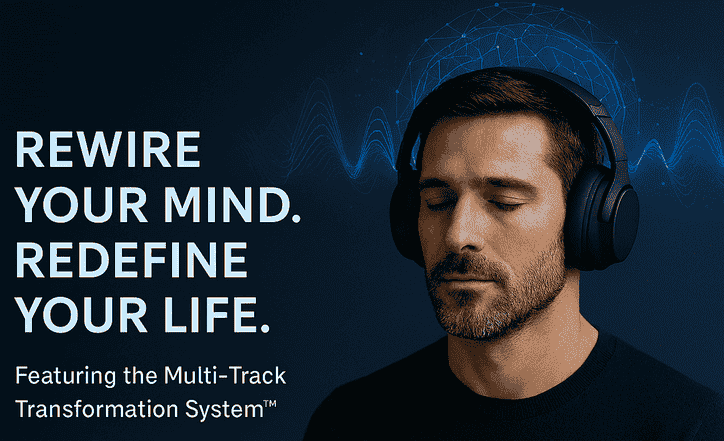
All our programs use theta brainwave frequencies and binaural beats to guide your mind into the deeply receptive state where subconscious change occurs most effectively — the same state often reached by experienced meditators, and where hypnotic suggestion creates its deepest and most lasting effects. Simply listen with headphones, relax, and allow the process to unfold naturally.
🧠 Most Specific Program
The Menopause Program supports memory recall, mental clarity, focus, motivation, and emotional balance during menopause or perimenopause with hypnosis — helping you feel calm, sharp, and confident when it matters most.
The Sleep / Insomnia Program creates positive change from the inside out by quieting the mind, reducing restlessness, and helping you enjoy deeper, more refreshing and restorative sleep each night.
The Freedom from Anxiety Program dissolves stress, worry and overwhelm at the deepest subconscious level with a powerful 4-track hypnosis system.
🧘 Another Powerful Program
The Deep Focus & Concentration Program is a 5-track subconscious system designed to build deep work states, concentration, and sustained mental clarity for high-performance focus.
through every area of your life.🎯 Need Something More Personalized?
While our pre-made programs are effective for most people, if your situation feels more complex, deeply embedded, or highly personal than what a general program can address, a tailored approach may offer a deeper level of support. Our Custom Hypnosis Recordings are personally designed for you, giving you the flexibility to target your specific goals and challenges through carefully engineered layered audio tracks, theta brainwave entrainment, binaural beats, and NeuroFrequency Programming™ - to guide the mind into deeply relaxed, highly receptive states where positive subconscious changes occur more naturally.
🎯 New to Relaxation / Self-Hypnosis?
Our complementary 12 Minute Relaxation provides a guided recording perfect for starting out, or for anyone wanting quick light relaxation. More free downloads also on this page, for sleep etc.

🎧 Recommended Programs for This Topic

Menopause Hypnosis
Support memory recall, mental clarity, focus, motivation, and emotional balance during menopause or perimenopause with hypnosis — helping you feel calm, sharp, and confident when it matters most.

Freedom from Anxiety Program
Dissolve stress, worry and overwhelm at the source, at the subconscious level, with this 4 track program.

Sleep / Insomnia
Drift into a deep satisfying night of sleep, with our subliminal recording of beautiful relaxation music which synchronizes brain waves.

Deep Meditation Program
Access the deepest levels of relaxation to bring inner peace into every area of your life.

Custom Hypnosis Recordings
Tailored specifically to your goals, challenges, and personal circumstances — offering the most precise and individualized path to deep subconscious change.