


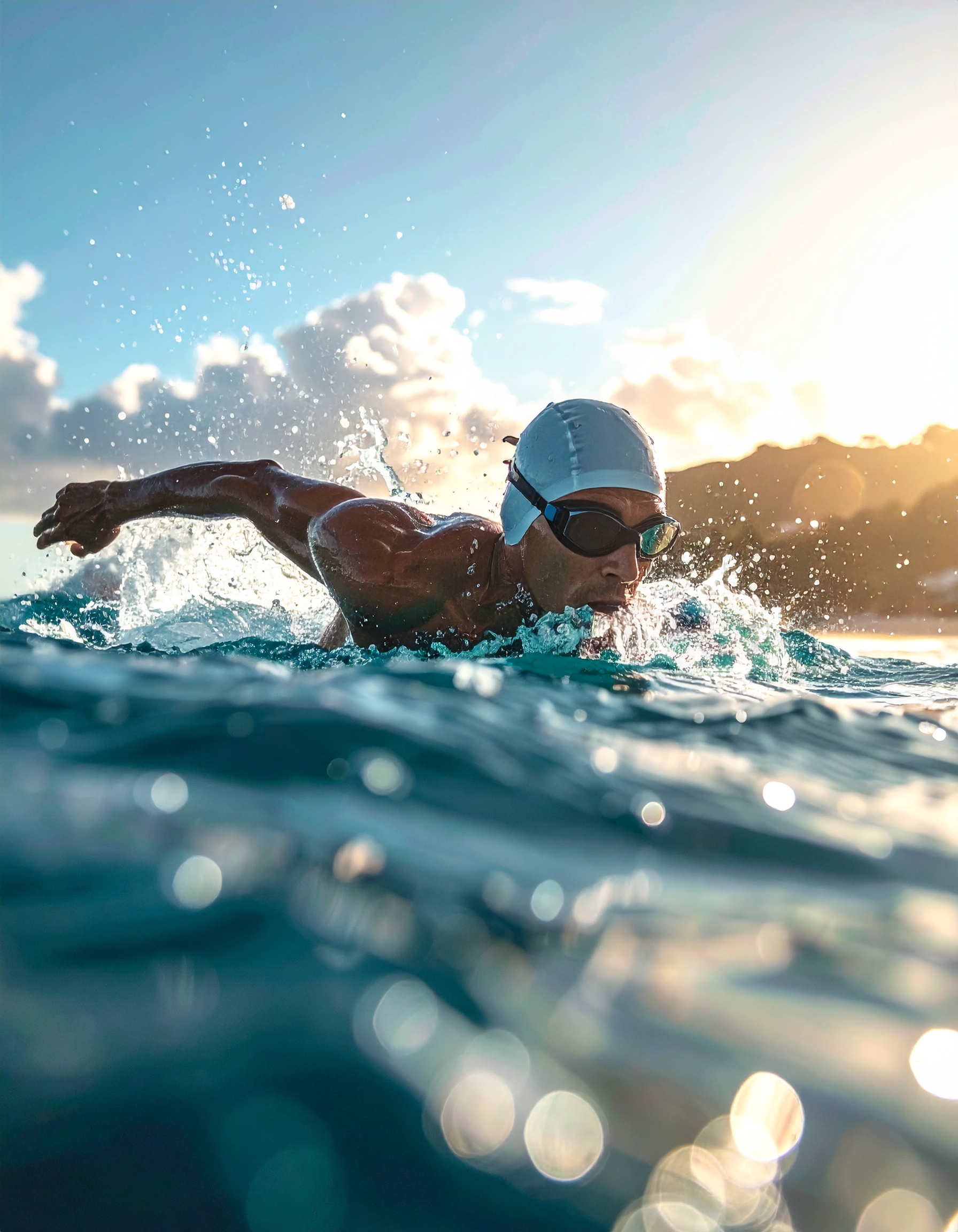
In the pool, the breathing is sorted. The rhythm is established, the bilateral pattern is consistent, the breath timing fits the stroke without conscious management. It is one of the elements of your swimming that has been grooved through repetition to the point where it largely takes care of itself - and in the controlled, predictable environment of the pool, it does.
And then comes the open water. The wave hits at the wrong moment and you get a mouthful instead of a breath. The chop is irregular and the breathing window that the pool guaranteed on every stroke is suddenly unreliable. The cold hits and the respiratory system reacts in ways the pool temperature never produced. The anxiety of the environment elevates and the breathing that was automatic becomes urgent, shallow, and fragmented in ways that feel alarmingly out of control for a swimmer who knows perfectly well how to breathe.
Breathing breakdown in open water is among the most common performance problems reported by swimmers at every level. And the reason it happens - and the reason it can be fixed far more effectively than most swimmers realize - lies in understanding exactly what the breathing pattern is actually responding to in the open water environment.
The breathing is not falling apart because the technique has deteriorated. It is falling apart because the nervous system state has changed - and the breathing, which is directly governed by that state, is simply reflecting it.
Why Breathing Is So Sensitive to Nervous System State
Breathing sits at a unique intersection of voluntary and involuntary control - it can be consciously managed, but it is also directly regulated by the autonomic nervous system in response to the body's perceived state. And this dual control makes it extraordinarily sensitive to subconscious threat assessment in ways that other aspects of swimming technique are not.
When the sympathetic nervous system activates - in response to cold, anxiety, environmental unfamiliarity, or any of the specific open water triggers that the subconscious processes as threat - the breathing pattern changes automatically and immediately. The rate increases. The depth decreases. The exhale shortens. The rhythm that was smooth and controlled becomes urgent and irregular. Not because the technique has failed, but because the autonomic nervous system has taken partial override of a system that, under the stress response, it prioritizes for survival over swimming.
"The breathing pattern in open water is not primarily a technique issue. It is a nervous system issue. Fixing the technique while the nervous system is in the wrong state is like adjusting the sails while the boat is taking on water - the real problem is below the surface."
This is why swimmers who have impeccable pool breathing technique still experience significant breathing problems in open water. The technique is not the variable. The nervous system state is. And the nervous system state in open water is routinely different from the nervous system state in the pool in ways that directly impair the breathing pattern regardless of how well it has been trained.
The Cold Shock Breathing Response
The most immediate and most physiologically powerful breathing disruption in open water is produced by cold water entry - specifically by the cold shock response that initial immersion in cold water reliably triggers.
Cold shock produces a sharp, involuntary gasp inhalation - the body's automatic respiratory response to the sudden temperature change. This is followed by a period of hyperventilation - rapid, uncontrolled breathing that is driven by the autonomic nervous system's emergency response to the cold and that can persist for the first sixty to ninety seconds of a cold water swim regardless of conscious intention to breathe normally.
The hyperventilation reduces carbon dioxide levels rapidly - which paradoxically creates a feeling of air hunger, not because oxygen is insufficient but because the CO2 signal that regulates the breathing urge has been disrupted. The swimmer feels like they cannot get enough air despite breathing rapidly. The urge to breathe becomes urgent and consuming. And the controlled, rhythmic breathing pattern that efficient swimming depends on becomes unavailable until the CO2 levels stabilize and the cold shock response subsides.
Understanding this response in advance - knowing that it is coming, knowing its duration, knowing that it is a predictable physiological event rather than a sign that something is wrong - significantly reduces the anxiety it generates. And reduced anxiety means a shorter and less severe cold shock response, because anxiety itself amplifies the sympathetic activation that is driving the hyperventilation.
The Wave and Chop Challenge
Beyond the cold shock period, open water breathing is challenged by the irregular surface conditions that eliminate the guaranteed breathing window that pool swimming provides. In the pool, the stroke rhythm creates a predictable space on every breath stroke where the head rotates and the breath is available. In open water, a wave can fill that space with water rather than air - and the resulting pattern of disrupted breaths creates a respiratory debt that compounds across repeated disruptions.
The swimmer who manages this well is not the one with better technique. They are the one whose subconscious relationship with breathing disruption is calm rather than anxious. Each missed breath or mouthful of water is processed as an ordinary feature of open water swimming rather than as an emergency requiring an urgent breathing response. The rhythm adjusts, the next available breath is taken efficiently, and the pattern re-establishes without the panic amplification that turns a single disrupted breath into a breathing crisis.
The swimmer whose subconscious treats each breathing disruption as an emergency generates a heightened respiratory urgency with each occurrence - and the urgency itself, by increasing breathing rate and reducing breath quality, makes the next disruption more likely and more difficult to manage. The breathing falls apart not because the conditions are unmanageable but because the subconscious response to them has created a self-amplifying cycle.
Rebuilding Breathing Stability at the Right Level
The most effective approach to open water breathing problems involves working at two levels simultaneously - the technical and the subconscious - with the understanding that technical improvements have limited value until the nervous system state that is overriding them has been addressed.
At the technical level: developing a bilateral breathing pattern that provides multiple options per stroke cycle rather than a single window; practicing exhaling fully and continuously underwater to maximize the air available in the breathing window; rehearsing the specific recovery pattern from a disrupted breath until it is automatic; and developing the exhale-first response to breathing disruption that activates the parasympathetic brake rather than amplifying the sympathetic response.
At the subconscious level: building a genuinely calm subconscious relationship with the specific triggers that are producing the nervous system state disrupting the breathing - cold water entry, wave conditions, breathing disruption itself. When the subconscious stops treating these stimuli as emergency signals, the autonomic override of the breathing pattern reduces, and the technically trained breathing becomes available in the environment it was trained for.
- Cold water entry produces a predictable, temporary breathing disruption - knowing this reduces the anxiety that amplifies it
- Wave disruption is manageable when the subconscious response to it is calm rather than urgent
- The exhale is the control lever - slow, deliberate exhale activates the parasympathetic system and reduces the panic amplification of breathing problems
- Subconscious desensitization to breathing disruption builds the automatic calm response that technical training alone cannot provide
The Exhale as the Reset Button
Across all open water breathing challenges - cold shock, wave disruption, anxiety-driven hyperventilation - the single most consistently effective immediate intervention is the deliberate, extended exhale. Not the inhale, which the anxiety response is urgently seeking, but the exhale that the anxiety response is shortening.
Extended exhale stimulates the vagus nerve, activating the parasympathetic nervous system in a way that directly counters the sympathetic activation driving the breathing disruption. It forces a slowing of the respiratory rate that the sympathetic override was accelerating. And it creates the space - both physiologically and psychologically - in which the controlled, rhythmic breathing pattern that efficient open water swimming requires can re-establish.
This response, practiced in the theta state until it is a pre-programmed subconscious automatic reaction, becomes genuinely available in the open water conditions that currently produce the opposite. Not a technique remembered under pressure - a conditioned subconscious response that activates before the breathing problem has fully escalated.
Your breathing technique is not the problem. Your nervous system state is. Address the state - genuinely, at the level where it is actually being generated - and the breathing you have always been capable of becomes consistently available in the water you are actually swimming in.
 🏊 Open Water Swimming Hypnosis Program
Build the subconscious calm that keeps your breathing pattern stable under open water conditions - desensitizing the cold shock response, the chop disruption, and the anxiety triggers that have been overriding the breathing technique you have already trained.
Learn more about the Open Water Hypnosis Program →
🎯 Need Something More Personalized?
While our pre-made programs are effective for most people, if your situation feels more complex, deeply embedded, or highly personal than what a general program can address, a tailored approach may offer a deeper level of support. Our Custom Hypnosis Recordings are personally designed for you, giving you the flexibility to target your specific goals and challenges through carefully engineered layered audio tracks, theta brainwave entrainment, binaural beats, and NeuroFrequency Programming™ - to guide the mind into deeply relaxed, highly receptive states where positive subconscious changes occur more naturally.
🎯 New to Relaxation / Self-Hypnosis?
Our complementary 12 Minute Relaxation provides a guided recording perfect for starting out, or for anyone wanting quick light relaxation. More free downloads also on this page, for sleep etc.

🎧 Recommended Programs for This Topic

Mind Training for Open Water Swimmers Program
Improve race focus, pacing control, and confidence in water with subconscious training designed for pool and open-water performance.

Triathlon Program
Strengthen mental endurance, transition focus, and race resilience across swim, bike, and run with integrated subconscious conditioning.

Distance Running
Enhance endurance, sharpen mental focus, and maintain steady pace under pressure with proven visualization techniques for runners.
Shop
See our entire selection of powerful hypnotic sports programs