


Online Hypnosis vs In-Person: Does It Work the Same Way?
Research from Stanford Medicine shows that hypnotic responsiveness is not dependent on physical setting, but on attentional absorption and neural connectivity patterns in the brain’s salience and default mode networks. In other words, your brain does not “care” whether the voice guiding you is in the room or coming through headphones, it cares whether it can follow, focus, and accept suggestion. This immediately challenges one of the most common assumptions people hold about hypnosis, that proximity equals effectiveness.
Here is the thing. You already know hypnosis works through focus and imagination. The real issue is that most people confuse “experience” with “delivery method,” when in reality the subconscious mind responds to pattern, repetition, and emotional relevance far more than physical presence.
Research Snapshot
• Hypnotic responsiveness varies more by attentional control than environment (Spiegel, Stanford)
• Online therapeutic outcomes for anxiety and habit change show comparable effect sizes to in-person delivery in multiple meta-analyses
• Brain imaging studies show similar neural activation patterns during guided imagery whether audio is live or recorded
“The brain enters trance through focus, not location.” - David Spiegel
The Real Mechanism Behind Hypnosis
Hypnosis is often misunderstood as something that requires presence, atmosphere, or ritual. In reality, it is a shift in attentional control systems, where the conscious mind reduces interference and the subconscious becomes more responsive to suggestion and imagery. This is not about sleep or unconsciousness, it is about narrowed focus combined with increased internal imagery processing.
You already experience this daily. When you are absorbed in a podcast, a film, or even driving a familiar route and missing conscious awareness of time, your brain is already demonstrating the same mechanisms that make hypnosis effective.
Why Online Hypnosis Works Surprisingly Well
Online hypnosis works because the key ingredients remain intact: voice guidance, attentional narrowing, and sustained imagery. The subconscious mind does not evaluate spatial context the way the conscious mind does. Instead, it responds to rhythm, tone, repetition, and meaning.
This is where online delivery often has an unexpected advantage. When you are in your own environment, your nervous system is already calibrated to safety. There is no travel stress, no social awareness, no performance pressure. That reduction in external load allows deeper internal absorption.
In Practice
In years of working with athletes and performance clients, I have consistently observed that clients often enter deeper hypnotic absorption in their own environment than in a clinical room. This pattern appears across elite performers and everyday clients regardless of experience level, which suggests that perceived safety and familiarity often matter more than physical setting.
In-Person Hypnosis: What It Actually Adds
In-person sessions do have value, but not for reasons most people assume. It is not the physical proximity that creates effectiveness, but the interactive calibration between practitioner and client. Subtle feedback loops, pacing adjustments, and conversational anchoring can refine the experience in real time.
However, for many clients, this added interaction is not essential for change. The subconscious does not require live correction once it has absorbed a well-structured suggestion pathway. What matters more is repetition over time rather than intensity in a single session.
The Reinforcement Effect: Why Recordings Often Win Long-Term
One of the most overlooked aspects of hypnosis is repetition. A single in-person session can be powerful, but a well-designed recording can be replayed dozens or even hundreds of times, each repetition strengthening neural pathways associated with the desired state.
This is where online and recorded hypnosis often outperform traditional formats. The subconscious mind learns through repetition, not novelty. Every replay deepens conditioning, stabilises emotional associations, and increases automaticity of response.
Safety, Control, and the Nervous System Advantage
Safety is a central factor in hypnotic responsiveness. When the nervous system perceives safety, the prefrontal cortex reduces resistance and the subconscious becomes more receptive to imagery and suggestion. This is why many people actually respond more easily at home than in unfamiliar environments.
Online hypnosis allows you to regulate your own environment. You choose the time, the space, the posture, and the level of comfort. That sense of control reduces sympathetic activation and supports parasympathetic engagement, which is the physiological gateway into deeper absorption.
So Does It Work the Same Way?
Yes, the mechanism is the same. The brain enters hypnotic absorption through focused attention and receptive imagination, not physical presence. What changes is not the effectiveness of hypnosis itself, but the conditions that support it.
In-person sessions offer interaction. Online hypnosis offers accessibility, repetition, and environmental safety. When combined, they often produce the strongest results, because they engage both immediate neural shift and long-term conditioning.
Closing insight: hypnosis is not defined by where it happens, but by how consistently the subconscious is guided into the same internal state. That is the foundation of NeuroFrequency Programming™, where repetition, imagery, and emotional encoding shape long-term change.

🔒 Related Solutions
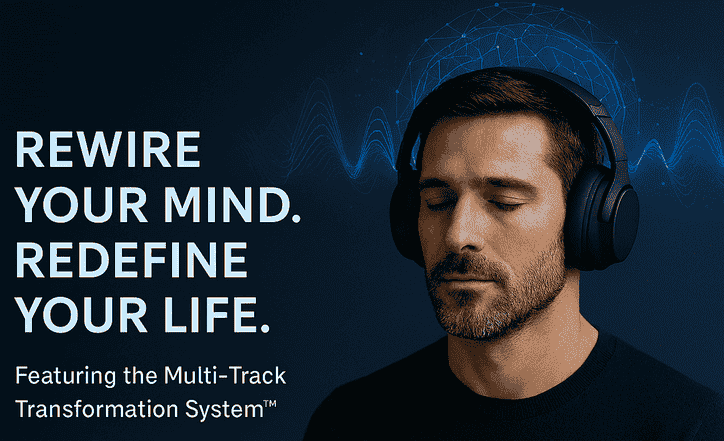
All our programs use theta brainwave frequencies and binaural beats to guide your mind into the deeply receptive state where subconscious change actually occurs - the same state reached by experienced meditators, and the level at which hypnotic suggestion produces its most lasting results. Simply listen with headphones, relax, and let the recordings do the work.
🧠 Most Specific Program
The Confidence / Self Esteem Hypnosis Program works directly at the deepest subconscious level to bring about positive changes from the inside, out - which can bring a wide and ongoing range of benefits to your everyday life.
🧘 Another Powerful Program
🧠 The Freedom from Anxiety Program contains a powerful 4-track hypnosis program designed to alleviate anxiety, stress and overwhelm at the subconscious source, by providing hypnotic tracks which can be safely used at various times throughout the day.
The Deep Meditation Program allows you to access the deepest levels of relaxation to allow inner peace and mental clarity to flow through every area of your life.
🎯 Need Something More Personalized?
While our pre-made programs are effective for most people, if your situation feels more complex, deeply embedded, or highly personal than what a general program can address, a tailored approach may offer a deeper level of support. Our Custom Hypnosis Recordings are personally designed for you, giving you the flexibility to target your specific goals and challenges through carefully engineered layered audio tracks, theta brainwave entrainment, binaural beats, and NeuroFrequency Programming™ - to guide the mind into deeply relaxed, highly receptive states where positive subconscious changes occur more naturally.
🎯 New to Relaxation / Self-Hypnosis?
Our complementary 12 Minute Relaxation provides a guided recording perfect for starting out, or for anyone wanting quick light relaxation. More free downloads also on this page, for sleep etc.

🎧 Recommended Programs for This Topic

Confidence & Self Esteem
Strengthen yourself from within to build confidence, self esteem, resilience, and a positive self image.

Freedom from Anxiety
Dissolve stress, worry and overwhelm at the deepest subconscious level with this powerful 4-track hypnosis system.

Deep Meditation Program
Access the deepest levels of relaxation to bring inner peace into every area of your life.

Weight Loss
Create an automatic mindset of healthy living to naturally support your body, boost fat-burning habits, and achieve lasting weight loss.

Health & Healing
Harness the power of hypnosis and visualization to strengthen your health and immune system from the inside, out.
Shop
See our entire selection of powerful hypnotic self help programs