


Why “Repetition in the Right State” Matters More Than Motivation
Neuroscience research on neuroplasticity has consistently shown that the brain changes through repeated patterns of activation rather than single moments of insight. Studies from researchers such as Dr. Michael Merzenich at UCSF and Dr. Alvaro Pascual-Leone at Harvard have demonstrated that neural circuits reorganize themselves based on repeated experience, attention, and emotional relevance.
This is where theta brainwave states become interesting.
Not because theta is magical.
But because it appears during the kinds of mental conditions where repetition has a stronger impact: focused attention, inward absorption, visualization, and reduced cognitive resistance.
Here is the thing. You do not build new neural pathways by trying harder once.
You build them by repeatedly activating the same pattern in a state where the brain is receptive enough to encode it.
Theta exposure is often discussed in hypnosis, meditation, and audio-based subconscious training because it tends to coincide with that receptivity window.
What Neuroplasticity Actually Means in Everyday Terms
Neuroplasticity simply means your brain is not fixed.
It is constantly reshaping itself based on what you repeatedly think, feel, imagine, and do.
Every habit you have is a strengthened neural pathway.
Every emotional reaction is a learned pattern of activation.
Every belief is a repeated interpretation your brain has reinforced over time.
Dr. Michael Merzenich’s work has shown that neurons that fire together tend to wire together, strengthening connections that are used frequently and weakening those that are not.
This creates a simple principle.
What you repeat becomes automatic.
What becomes automatic feels like “just who you are.”
But underneath that experience is a network of strengthened neural pathways.
Neuroplasticity does not require effortful thinking.
It requires consistent activation.
And this is where brain states like theta become relevant in applied settings like hypnosis and subconscious training.
The brain does not change because you understand something. It changes because you repeatedly experience it in a meaningful way.
Why Theta Is Often Linked to Learning and Internal Rewiring
Theta brainwaves typically appear during states of inward focus, imagination, light trance, and the transition into sleep.
These are not passive states.
They are internally active states where attention shifts away from external analysis and toward internal imagery, memory, and emotional processing.
Researchers such as Dr. Richard Davidson and Dr. Michael Gazzaniga have highlighted that the brain operates through distributed networks that constantly reorganize based on experience and attention.
When theta activity is present, the brain often shows patterns consistent with reduced external distraction and increased internal association.
This matters for neuroplasticity because repetition alone is not enough.
Repetition must occur in a state where the brain is actually encoding the experience rather than resisting it or filtering it out.
Theta appears to reduce that filtering effect, allowing repeated suggestions, imagery, or emotional cues to be processed more deeply.
Research Snapshot
• Neuroplasticity depends on repeated activation of neural circuits over time.
• Mental rehearsal alone can change brain structure and function.
• Theta states are commonly associated with inward attention, imagery, and reduced external distraction.
How Repetition in Theta Differs From Repetition in Normal Awareness
You repeat thoughts all day long.
You repeat beliefs.
You repeat emotional reactions.
But most of that repetition happens in a highly analytical, distracted, or externally focused state.
In that state, the brain is constantly filtering, evaluating, and comparing incoming information.
This creates resistance to change.
Now compare that to theta-associated states such as deep relaxation, hypnosis, visualization, or the transition into sleep.
In those states, the analytical filter softens.
Attention becomes more fluid.
Internal imagery becomes more dominant than external logic.
Neuroscientist Stanislas Dehaene’s work on consciousness highlights how access to information in the brain changes depending on attentional state and awareness levels.
This helps explain why the same repeated suggestion can feel ignored in a normal state but feel meaningful in a theta-like state.
It is not the content that changes.
It is the brain’s relationship to the content.
Why Emotional Engagement Accelerates Neural Pathway Formation
Neuroplasticity is not driven by repetition alone.
It is strongly influenced by emotional significance.
The more meaningful an experience feels, the more likely the brain is to encode it as important.
Dr. Joseph LeDoux’s research on emotional memory shows that emotional brain systems often process information faster and more powerfully than purely logical systems.
This is why fear-based memories can form quickly.
It is also why confidence, safety, and identity-based suggestions in hypnosis can be powerful when they are emotionally engaged rather than purely intellectual.
Theta states often amplify this process because internal imagery becomes more vivid and emotionally immersive.
This is where repeated exposure matters most.
Each repetition is not just repetition of words.
It is repetition of an internal experience.
And over time, the brain begins to treat that experience as familiar.
Familiarity becomes reduced resistance.
Reduced resistance becomes automatic response.
In Practice
In years of working with hypnosis and performance conditioning, I have consistently observed that the strongest subconscious shifts occur when repeated suggestions are paired with emotionally meaningful imagery during deeply absorbed states. Over time, clients begin to report that the new response feels less like a learned technique and more like their natural default way of thinking.
Why “Theta Exposure” Works Best Over Time, Not Instantly
One of the biggest misunderstandings about brainwave-based learning is the expectation of immediate change.
Theta exposure does not rewrite the brain in a single session.
It creates conditions for gradual reinforcement of new patterns.
Neuroplasticity is fundamentally cumulative.
Dr. Eric Kandel’s Nobel Prize-winning research showed that repeated stimulation strengthens synaptic connections over time, making neural responses more efficient and stable.
This means consistency matters more than intensity.
A single deep experience may feel powerful, but repeated moderate experiences often produce stronger long-term change.
Theta states support this process by making repetition feel less effortful and more naturally absorbed.
Instead of forcing change, the brain gradually reorganizes around repeated internal experiences.
This is why hypnosis, meditation, visualization, and audio-based subconscious training often emphasize daily repetition rather than occasional intense sessions.
Neural pathways are not built in moments of insight. They are built in repeated moments of experience that the brain begins to expect.
What This Means for Hypnosis, Audio Training, and Real Change
When you combine neuroplasticity research with brain state research, a clear pattern emerges.
The brain changes through repetition.
Repetition works best when resistance is low.
Resistance is often lower in theta-associated states.
This is why hypnosis recordings, visualization practices, and subconscious training audio often aim to guide listeners into relaxed, inward-focused attention states.
Not because theta is a shortcut.
But because it supports the natural conditions under which learning and rewiring occur.
Neuroscientist Michael Gazzaniga once described the brain as a system constantly constructing meaning from experience.
That construction process is ongoing.
Every repeated thought contributes to it.
Every repeated emotional response strengthens it.
Every repeated internal experience shapes it.
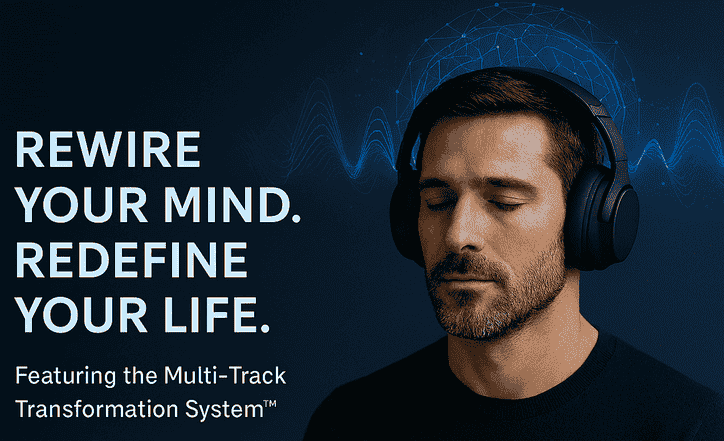
NeuroFrequency Programming™ applies this principle by combining structured repetition, focused attention, and theta-compatible audio environments to support the gradual formation of new neural pathways aligned with desired behavioral and emotional patterns.
The brain does not change because you try once. It changes because repeated experience in receptive states gradually becomes the new default pattern of who you are.

🔒 Related Solutions
All our programs use theta brainwave frequencies and binaural beats to guide your mind into the deeply receptive state where subconscious change actually occurs - the same state reached by experienced meditators, and the level at which hypnotic suggestion produces its most lasting results. Simply listen with headphones, relax, and let the recordings do the work.
🧠 Most Specific Program
The Confidence / Self Esteem Hypnosis Program works directly at the deepest subconscious level to bring about positive changes from the inside, out - which can bring a wide and ongoing range of benefits to your everyday life.
The Freedom from Anxiety Program dissolves stress, worry and overwhelm at the deepest subconscious level with a powerful 4-track hypnosis system.
The Deep Focus & Concentration Program is a 5-track subconscious system designed to build deep work states, concentration, and sustained mental clarity for high-performance focus.
🧘 Another Powerful Program
The Deep Meditation Program allows you to access the deepest levels of relaxation to allow inner peace and mental clarity to flow through every area of your life.
🎯 Need Something More Personalized?
While our pre-made programs are effective for most people, if your situation feels more complex, deeply embedded, or highly personal than what a general program can address, a tailored approach may offer a deeper level of support. Our Custom Hypnosis Recordings are personally designed for you, giving you the flexibility to target your specific goals and challenges through carefully engineered layered audio tracks, theta brainwave entrainment, binaural beats, and NeuroFrequency Programming™ - to guide the mind into deeply relaxed, highly receptive states where positive subconscious changes occur more naturally.
🎯 New to Relaxation / Self-Hypnosis?
Our complementary 12 Minute Relaxation provides a guided recording perfect for starting out, or for anyone wanting quick light relaxation. More free downloads also on this page, for sleep etc.

🎧 Recommended Programs for This Topic

Confidence & Self Esteem
Strengthen yourself from within to build confidence, self esteem, resilience, and a positive self image.

Freedom from Anxiety Program
Dissolve stress, worry and overwhelm at the source, at the subconscious level, with this 4 track program.

Weight Loss
Create an automatic mindset of healthy living to naturally support your body, boost fat-burning habits, and achieve lasting weight loss.

Health & Healing
Harness the power of hypnosis and visualization to strengthen your health and immune system from the inside, out.

Sleep / Insomnia
Drift into a deep satisfying night of sleep, with our subliminal recording of beautiful relaxation music which synchronizes brain waves.

Custom Hypnosis Recordings
Tailored specifically to your goals, challenges, and personal circumstances — offering the most precise and individualized path to deep subconscious change.
Shop
See our entire selection of powerful hypnotic self help programs
What Is NeuroFrequency Programming™? Craig Townsend's Method Explained
Discover the multi-layered method that combines advanced hypnosis techniques with targeted brainwave frequencies to create deeper, faster, and more lasting subconscious change.