


How Hypnosis Evolved Into a Scientific Field of Mind Change
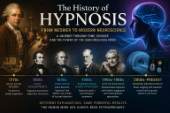
The history of hypnosis begins long before the word itself existed, but modern research allows us to trace its evolution from early magnetic theories to today’s neuroscience-based understanding of attention and suggestion. One of the most important turning points came when Stanford researchers began mapping hypnotic states using brain imaging, showing measurable changes in the anterior cingulate cortex and default mode network during hypnosis. This shifted hypnosis from mystical speculation into observable cognitive science.
Here is the thing. You already know hypnosis has been controversial for centuries. The real issue is that early interpretations were shaped by belief systems, not neuroscience. What we now call hypnosis has always existed as focused attention, but its explanation has changed dramatically over time.
Research Snapshot
• fMRI studies show distinct neural signatures during hypnosis in highly suggestible individuals (Spiegel, Stanford)
• Historical placebo and suggestion effects were documented as early as 18th century Mesmerian practices
• Modern meta-analyses show hypnosis produces measurable effects in pain, anxiety, and habit regulation across clinical trials
“Hypnosis is focused attention with reduced self-criticism.” - David Spiegel
Franz Mesmer and the Era of “Animal Magnetism”
In the late 18th century, Franz Anton Mesmer proposed that invisible forces, which he called “animal magnetism,” could influence health and behaviour. While his explanation was incorrect, his observations were not. People entered altered states of suggestibility during his treatments, often reporting emotional release, physical relaxation, and behavioural change.
This is important. The mechanism was real even if the interpretation was not. Mesmer was observing early forms of hypnotic responsiveness without the language of neuroscience, psychology, or cognition.
The Shift From Mysticism to Psychology
In the 19th and early 20th centuries, hypnosis began to move away from magnetic theories and into psychological frameworks. Researchers such as James Braid redefined hypnosis as a state of focused attention rather than external force. This was the first major step toward the modern scientific understanding of hypnotic phenomena.
You already know how powerful focus can feel. The real issue is that early practitioners were describing subjective experience without understanding the underlying attentional systems driving it.
Milton Erickson and the Modern Clinical Revolution
A major transformation occurred with Milton Erickson, who shifted hypnosis into conversational, indirect, and highly individualized approaches. Rather than formal induction scripts, Erickson used language patterns, storytelling, and embedded suggestion to engage subconscious processing naturally.
This changed everything. Hypnosis stopped being something you “entered” and became something woven into communication itself. This approach now underpins much of modern clinical hypnosis and performance coaching.
The Neuroscience Era: Hypnosis Becomes Measurable
Modern neuroscience has confirmed what early practitioners observed intuitively. Hypnosis is associated with changes in functional connectivity between brain regions involved in self-monitoring, attention regulation, and sensory processing. These changes help explain why suggestions can feel internally generated rather than externally imposed.
This is not theory anymore. Brain imaging studies consistently show that hypnotic states are identifiable, reproducible, and distinct from ordinary waking cognition in highly responsive individuals.
Why Hypnosis Survived Every Scientific Challenge
Hypnosis has survived centuries of skepticism because it produces consistent experiential and behavioural outcomes, even when explanations differ. Whether framed as magnetism, psychology, or neuroscience, the underlying mechanism remains attentional absorption combined with suggestion.
You already know this pattern from everyday life. When attention is fully absorbed, critical filtering decreases and internal imagery becomes more influential in shaping perception and behaviour.
From Mesmer to Modern Practice: What Actually Matters Now
Today, hypnosis is best understood as a structured method of directing attention, imagery, and expectation to influence subconscious learning. The historical journey matters because it shows a consistent truth. The mechanism was always present, even when the explanations were not.
What has changed is precision. Modern hypnosis integrates neuroscience, cognitive psychology, and behavioural science into structured approaches that can be replicated, measured, and refined over time.
Closing insight: hypnosis has evolved from mystical interpretation into applied neuroscience of attention and learning. That evolution forms the foundation of NeuroFrequency Programming™, where subconscious conditioning is built through structured repetition, focused imagery, and scientifically grounded suggestion.

🔒 Related Solutions
All our programs use theta brainwave frequencies and binaural beats to guide your mind into the deeply receptive state where subconscious change actually occurs - the same state reached by experienced meditators, and the level at which hypnotic suggestion produces its most lasting results. Simply listen with headphones, relax, and let the recordings do the work.
🧠 Most Specific Program
The Confidence / Self Esteem Hypnosis Program works directly at the deepest subconscious level to bring about positive changes from the inside, out - which can bring a wide and ongoing range of benefits to your everyday life.
🧘 Another Powerful Program
🧠 The Freedom from Anxiety Program contains a powerful 4-track hypnosis program designed to alleviate anxiety, stress and overwhelm at the subconscious source, by providing hypnotic tracks which can be safely used at various times throughout the day.
The Deep Meditation Program allows you to access the deepest levels of relaxation to allow inner peace and mental clarity to flow through every area of your life.
🎯 Need Something More Personalized?
While our pre-made programs are effective for most people, if your situation feels more complex, deeply embedded, or highly personal than what a general program can address, a tailored approach may offer a deeper level of support. Our Custom Hypnosis Recordings are personally designed for you, giving you the flexibility to target your specific goals and challenges through carefully engineered layered audio tracks, theta brainwave entrainment, binaural beats, and NeuroFrequency Programming™ - to guide the mind into deeply relaxed, highly receptive states where positive subconscious changes occur more naturally.
🎯 New to Relaxation / Self-Hypnosis?
Our complementary 12 Minute Relaxation provides a guided recording perfect for starting out, or for anyone wanting quick light relaxation. More free downloads also on this page, for sleep etc.

🎧 Recommended Programs for This Topic

Confidence & Self Esteem
Strengthen yourself from within to build confidence, self esteem, resilience, and a positive self image.

Freedom from Anxiety
Dissolve stress, worry and overwhelm at the deepest subconscious level with this powerful 4-track hypnosis system.

Deep Meditation Program
Access the deepest levels of relaxation to bring inner peace into every area of your life.

Weight Loss
Create an automatic mindset of healthy living to naturally support your body, boost fat-burning habits, and achieve lasting weight loss.

Health & Healing
Harness the power of hypnosis and visualization to strengthen your health and immune system from the inside, out.
Shop
See our entire selection of powerful hypnotic self help programs