



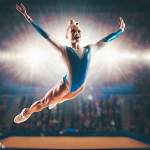
You're standing at the end of the runway. Or at the edge of the beam. Or waiting for your cue on floor. The skill is one you've done before - maybe hundreds of times. Your body knows exactly what to do. And yet something in you simply will not go.
This is the gymnastics mental block. And if you've experienced it, you know how bewildering it is - not just the block itself, but the complete inability to override it no matter how hard you try. You can want to do the skill with everything you have and still find that wanting isn't enough.
Understanding why this happens - at the neurological level - is the first step toward actually doing something about it.
Your Brain Is Not Broken - It's Protecting You
The most important reframe for any gymnast dealing with a mental block is this: your brain is not malfunctioning. It is doing exactly what it was designed to do. It has identified a movement pattern as potentially dangerous and activated a protection response to prevent you from executing it. From a pure survival standpoint, that's the system working perfectly.
The problem is that the threat assessment is based on old information - a fall, a bad rep, a moment of fear that the amygdala logged as evidence of danger and has been acting on ever since. The skill may be entirely safe. Your technique may be solid. But the subconscious is running from a different data set, and it doesn't update automatically just because time has passed or your coach tells you you're ready.
The block isn't weakness. It isn't a lack of mental toughness. It's a highly efficient threat response operating on outdated information - and the way to resolve it is to update the information, not to force through the response.
The Neuroscience of What's Happening
When you approach a skill that has a mental block attached to it, your amygdala fires a threat signal before your conscious mind has time to intervene. This signal triggers a cascade of physiological responses - elevated cortisol and adrenaline, increased muscle tension, narrowed attention, activation of the freeze response - all of which make the fluid, automatic execution of a complex gymnastics skill neurologically impossible in that moment.
The prefrontal cortex - responsible for rational assessment, voluntary movement initiation, and the override of fear responses - is partially suppressed by the amygdala activation. This is why telling yourself it's fine, reminding yourself you've done it before, and consciously deciding to just go doesn't work. The rational brain is trying to override a system that, in threat mode, it simply doesn't have authority over.
The freeze response itself is particularly relevant in gymnastics mental blocks. Freeze is one of the three primary threat responses alongside fight and flight - and it's the one activated when the brain assesses that neither fighting nor fleeing is an option. Standing at the end of the runway with coaches watching and nowhere to go, the nervous system defaults to freeze. The body literally will not move.
Why It Often Starts With One Moment
Mental blocks in gymnastics frequently trace back to a single incident - a fall on a specific skill, a competition performance that went badly, a moment where something felt dangerously out of control. It doesn't have to be a serious injury. The amygdala forms strong associations from single significant emotional events, particularly ones involving physical threat or intense fear.
From that one moment the subconscious builds a rule: this skill equals danger. Every subsequent approach to the skill reactivates that association, reinforcing it each time the block is experienced. The neural pathway connecting this movement pattern to threat gets stronger with every failed attempt, which is one reason blocks tend to deepen over time rather than resolve on their own.
Some gymnasts can't identify a specific starting incident - the block seemed to appear from nowhere. But something always triggered it, even if the conscious mind has lost access to the memory. The subconscious holds it regardless.
The Role of Procedural Memory
Gymnastics skills, once learned and consolidated, are stored in procedural memory - a deep subconscious system that executes complex movement sequences automatically without requiring conscious direction. This is why experienced gymnasts don't think through each phase of a skill as they perform it. The body runs the program while the conscious mind stays out of the way.
A mental block doesn't erase the procedural memory. The skill is still stored exactly where it was. What happens is that the amygdala's threat signal interrupts the execution of the program before it can complete - placing a neurological barrier between the stored skill and its expression. The program exists. The brain won't run it.
This distinction matters because it means the work of overcoming a mental block isn't about relearning the skill. It's about removing the barrier - updating the threat signal so the brain allows the existing program to execute.
What Doesn't Work and Why
Most conventional approaches to gymnastics mental blocks focus on the conscious level - more repetitions, positive self-talk, commitment drills, forced attempts. These approaches sometimes work for mild or early-stage blocks, but for an established block they frequently make things worse.
Forced attempts that don't complete add more data to the subconscious's threat file. Emotional pressure from coaches or parents increases the overall threat load the nervous system is managing. Positive self-talk reaches the conscious mind but doesn't penetrate to the amygdala, where the block is actually being generated. And the accumulation of failed attempts erodes confidence in ways that extend beyond the specific skill.
The fundamental problem with conscious-level interventions is that they're addressing a subconscious response. You can't argue with your amygdala. You can't will your way past a freeze response. You need to work at the level where the block lives.
What Actually Works
Effective resolution of a gymnastics mental block requires accessing the subconscious directly - updating the threat association at the level where it was formed rather than trying to override it from above.
Hypnosis creates the conditions for this by inducing a deeply relaxed, receptive state in which the subconscious is open to new information. The emotional memory associated with the block can be revisited safely, its charge reduced, and new associations built around the skill - ones that connect it to safety, capability, and successful completion rather than threat and failure.
Consistent mental rehearsal in a relaxed state builds a neural record of successful performance that gradually becomes as real to the subconscious as the original fear memory. The brain begins to have two competing data sets - the old threat association and the new success association - and with enough repetition the new one gains dominance.
A progressive return to the skill, structured carefully to accumulate genuine success experiences rather than forced attempts, rebuilds the procedural confidence the block has eroded. Each successful rep at a manageable level updates the subconscious's risk assessment in a way that lectures and encouragement simply cannot.
There Is a Way Back
Gymnastics mental blocks resolve. Not always quickly, not always linearly, but they resolve - when they're approached with the right understanding and addressed at the right level. The brain that learned to refuse the skill can learn to allow it again, because the threat association that's blocking it was learned, and what was learned can be unlearned.
The skill is still there. The athlete is still capable. What needs to change is the subconscious's assessment of whether it's safe to show it - and that assessment, with the right approach, can absolutely be changed.

🔒 Related Solutions
All our programs use theta brainwave frequencies and binaural beats to guide your mind into the deeply receptive state where subconscious change actually occurs - the same state reached by experienced meditators, and the level at which hypnotic suggestion produces its most lasting results. Simply listen with headphones, relax, and let the recordings do the work.
🧠 Most Specific Program
The Gymnastics Tumbling Fears Hypnosis Program (plus also a program for Cheerleaders) work directly at the deepest subconscious level to reduce fear and anxiety, to bring improvement to all areas of performance.
The Freedom from Anxiety Program dissolves stress, worry and overwhelm at the deepest subconscious level with a powerful 4-track hypnosis system.
The Deep Focus & Concentration Program is a 5-track subconscious system designed to build deep work states, concentration, and sustained mental clarity for high-performance focus.
🎯 Need Something More Personalized?
While our pre-made programs are effective for most people, if your situation feels more complex, deeply embedded, or highly personal than what a general program can address, a tailored approach may offer a deeper level of support. Our Custom Hypnosis Recordings are personally designed for you, giving you the flexibility to target your specific goals and challenges through carefully engineered layered audio tracks, theta brainwave entrainment, binaural beats, and NeuroFrequency Programming™ - to guide the mind into deeply relaxed, highly receptive states where positive subconscious changes occur more naturally.
🎯 New to Relaxation / Self-Hypnosis?
Our complementary 12 Minute Relaxation provides a guided recording perfect for starting out, or for anyone wanting quick light relaxation. More free downloads also on this page, for sleep etc.

🎧 Recommended Programs for This Topic

Gymnastics Tumbling Fears
Overcome tumbling fears, build confidence in execution, and develop calm control under pressure with subconscious training designed for performance consistency.

Custom Sports Hypnosis Recordings
Recordings built specifically around your goals, training and challenges - the most targeted way to use hypnosis for lasting change.