



Why Confidence Does Not Break Because of Skill, But Because of Subconscious Belief
Research in self-efficacy from psychologist Albert Bandura shows that belief in your ability strongly predicts performance outcomes across sports, business, and learning environments, and in many cases it is a stronger predictor than raw skill level itself, which explains why two people with similar ability can perform in completely different ways under pressure.
Here is the thing. Confidence is rarely a skill issue.
It is usually a subconscious belief issue.
One person walks into a challenge expecting to perform well, adapt well, and recover quickly from mistakes, while another walks in silently expecting hesitation, doubt, and potential failure even if both have trained equally hard.
The difference is not effort.
The difference is internal programming.
This matters because the subconscious mind does not respond to logic alone. It responds to repeated emotional experience, identity conditioning, and stored patterns of success or failure.
Confidence is not something you think into existence. It is something your nervous system learns through repetition and identity reinforcement.
Many people try to build confidence by forcing positive thinking, but if the subconscious system does not believe the message, it will not hold under pressure, especially in situations that feel emotionally loaded or socially evaluative.
Why the Subconscious Mind Controls Confidence More Than Conscious Thought
The conscious mind can set goals, repeat affirmations, and attempt to reason through fear, but the subconscious mind governs automatic emotional responses, self-talk patterns, body language, and stress reactions that occur instantly in real situations, which is why confidence often collapses under pressure even when conscious motivation is strong.
Here is the thing. If the subconscious mind is carrying doubt, fear, or past failure patterns, it will override conscious intention the moment pressure increases, because under stress the brain prioritises safety and familiarity over logical reasoning.
This is why confidence feels inconsistent for so many people. In calm environments they feel capable, but in high-stakes environments the nervous system shifts into protection mode, increasing self-monitoring, hesitation, and fear of mistakes.
Psychologist Timothy Wilson’s work on the adaptive unconscious highlights how much of human behaviour is driven by subconscious processing rather than conscious decision-making, especially under emotional load.
In confidence terms, this means you are not dealing with one mind, but two layers of processing, where the deeper layer often determines the final outcome.
Research Snapshot
• Self-efficacy strongly predicts performance under pressure (Albert Bandura research)
• Subconscious processing drives most real-time behavioural responses (Timothy Wilson research)
• Stress reduces working memory capacity and increases self-doubt loops (Daniel Kahneman research)
Over time, repeated emotional experiences shape the subconscious identity of “how you tend to perform,” which is why confidence is not just situational but deeply learned.
How Hypnosis Rebuilds Confidence at the Level Where It Actually Forms
Hypnosis works differently from conscious mindset techniques because it directly accesses the subconscious processing system where emotional memory, identity patterns, and automatic self-belief structures are stored and updated through experience.
In a hypnotic state, the brain becomes more receptive to suggestion, imagery, and emotional rehearsal, which allows new identity patterns such as capability, calmness, adaptability, and self-trust to be experienced internally in a way that feels real to the nervous system rather than purely conceptual.
This is important because the subconscious mind does not distinguish strongly between vividly imagined experience and real experience when emotions are activated, which is why repeated hypnotic rehearsal can begin to overwrite older confidence patterns that were built through past failure or uncertainty.
🧠 Key principle: The subconscious mind learns confidence through emotional repetition, not intellectual understanding, which is why hypnosis focuses on experience-based internal rehearsal rather than logic-based persuasion.
Researchers like David Spiegel at Stanford and Irving Kirsch at Harvard have shown that hypnotic states can alter perception, emotional processing, and expectation systems in measurable ways, which helps explain why people often report changes in self-confidence after consistent hypnotic work rather than after one-off motivational interventions.
Milton Erickson, one of the most influential figures in clinical hypnosis, often emphasised indirect learning through experience rather than instruction, which aligns closely with how subconscious confidence is actually formed.
Why Self-Doubt Is Often a Learned Protection Strategy
Many people assume self-doubt is a flaw, but in most cases it is actually a protective pattern the subconscious mind developed to reduce risk, embarrassment, or emotional pain based on past experiences where confidence was punished, rejected, or not rewarded.
This means self-doubt is often not random, but structured, meaning it activates in specific situations where the brain predicts potential threat such as social evaluation, performance pressure, or uncertainty.
Psychologist Martin Seligman’s research on learned helplessness shows how repeated exposure to perceived failure without control can condition the brain into reduced confidence and reduced initiative, even when capability remains intact.
Here is the thing. The subconscious mind prefers familiar emotional outcomes over uncertain ones, even if those outcomes are limiting, which is why doubt can feel automatic and persistent.
Self-doubt is often not truth. It is repetition.
Hypnosis becomes powerful here because it allows the subconscious system to rehearse alternative outcomes where action is taken, mistakes are handled calmly, and identity remains stable even when performance is imperfect.
How Hypnosis Builds Real Confidence That Holds Under Pressure
Real confidence is not the absence of fear, but the ability to remain internally stable while fear or uncertainty is present, and hypnosis trains exactly this capacity by repeatedly exposing the subconscious mind to calm performance states under imagined pressure conditions.
Instead of trying to eliminate doubt, hypnosis teaches the nervous system to function effectively despite it, which is why many people report feeling more grounded, less reactive, and more decisive after consistent practice.
One short expert insight from Albert Bandura captures this principle clearly:
“Belief in capability shapes action.”
In hypnosis-based confidence work, this belief is not forced through repetition of words alone but installed through repeated emotional experiences of success, adaptability, and calm execution within the subconscious imagination.
Over time, the nervous system begins to default to more stable emotional responses because those responses have been rehearsed more often internally than older fear-based patterns.
Visualization as a Bridge Between Hypnosis and Real-World Confidence
Visualization strengthens hypnotic confidence work because it creates repeated internal simulations of success, allowing the brain to rehearse confident behaviour patterns before they are needed in real life situations.
When a person repeatedly visualises themselves speaking clearly, performing well, handling mistakes calmly, and recovering quickly from setbacks, the nervous system begins to treat those responses as familiar rather than foreign, which reduces anxiety when similar situations arise in reality.
Neuroscientist Alvaro Pascual-Leone demonstrated that mental rehearsal activates overlapping neural networks with physical execution, which means the brain practices real performance even without physical action.
This is why elite performers often combine hypnosis, visualization, and mental rehearsal rather than relying on motivation alone.
The nervous system becomes calmer when success feels familiar rather than uncertain.
When confidence is rehearsed consistently in this way, it becomes less of a mood and more of an internal baseline state.
True Confidence Is Stability, Not Elimination of Doubt
One of the most important misunderstandings about confidence is the belief that confident people do not feel fear or doubt, when in reality most confident individuals still experience uncertainty, but they interpret it differently and do not allow it to disrupt their behaviour or identity.
Psychologist Richard Petty’s research on attitude strength shows that confidence is not simply a feeling but a structured belief system that determines how resistant a person is to doubt under pressure.
Here is the thing. Trying to eliminate all doubt often increases internal pressure, whereas building stability within doubt produces far more reliable confidence in real-world environments.
Hypnosis supports this by training the subconscious mind to remain organised under emotional load, where thoughts, sensations, and pressure cues are processed without triggering collapse into avoidance or hesitation.
The most confident people are not free from doubt. They are stable within it.
Across neuroscience, psychology, and performance research, the pattern is consistent: confidence is not built through positive thinking alone but through repeated subconscious experiences of capability, emotional regulation, and identity reinforcement, which is exactly where hypnosis becomes a powerful tool for long-term change.
Within NeuroFrequency Programming™, these principles are applied by conditioning the subconscious mind toward stable self-belief patterns that remain active under pressure, allowing individuals to access their skills, knowledge, and ability without being blocked by internal doubt loops that otherwise interfere with performance and expression.

🔒 Related Solutions
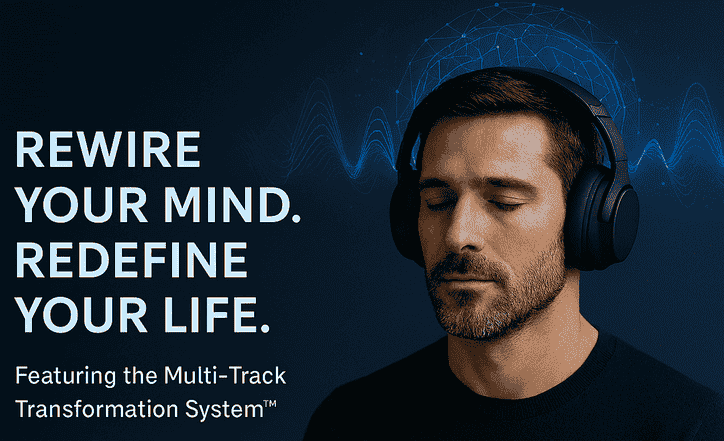
All our programs use theta brainwave frequencies and binaural beats to guide your mind into the deeply receptive state where subconscious change actually occurs - the same state reached by experienced meditators, and the level at which hypnotic suggestion produces its most lasting results. Simply listen with headphones, relax, and let the recordings do the work.
🧠 Most Specific Program
The Confidence / Self Esteem Hypnosis Program works directly at the deepest subconscious level to bring about positive changes from the inside, out - which can bring a wide and ongoing range of benefits to your everyday life.
🧘 Another Powerful Program
🧠 The Freedom from Anxiety Program contains a powerful 4-track hypnosis program designed to alleviate anxiety, stress and overwhelm at the subconscious source, by providing hypnotic tracks which can be safely used at various times throughout the day.
The Deep Meditation Program allows you to access the deepest levels of relaxation to allow inner peace and mental clarity to flow through every area of your life.
🎯 Need Something More Personalized?
While our pre-made programs are effective for most people, if your situation feels more complex, deeply embedded, or highly personal than what a general program can address, a tailored approach may offer a deeper level of support. Our Custom Hypnosis Recordings are personally designed for you, giving you the flexibility to target your specific goals and challenges through carefully engineered layered audio tracks, theta brainwave entrainment, binaural beats, and NeuroFrequency Programming™ - to guide the mind into deeply relaxed, highly receptive states where positive subconscious changes occur more naturally.
🎯 New to Relaxation / Self-Hypnosis?
Our complementary 12 Minute Relaxation provides a guided recording perfect for starting out, or for anyone wanting quick light relaxation. More free downloads also on this page, for sleep etc.

🎧 Recommended Programs for This Topic

Confidence & Self Esteem
Strengthen yourself from within to build confidence, self esteem, resilience, and a positive self image.

Imposter Syndrome Program
Resolve the subconscious self-concept gap at its source - permanently.

Deep Meditation Program
Access the deepest levels of relaxation to bring inner peace into every area of your life.

Public Speaking Confidence
The complete subconscious reconditioning program for genuine presentation confidence.
Shop
See our entire selection of powerful hypnotic self help programs