


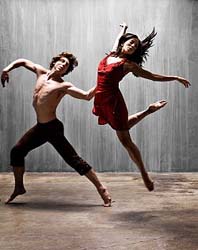
The routine is ready. You have performed it hundreds of times in the studio - cleanly, confidently, with the quality of expression and technical precision that represents your genuine level. Your teacher knows it is ready. You know it is ready. By any reasonable measure of preparation, you are prepared.
And then the competition floor opens up and something changes. The quality of movement that was available in the studio becomes harder to access. The expression that flows naturally in rehearsal feels effortful and self-conscious under the lights. The routine that was automatic becomes something you are managing rather than inhabiting - and the performance that emerges is a diminished version of what you know yourself to be capable of.
The response, almost universally, is to do more. More rehearsal. More repetitions. More polish on the technical elements. The assumption being that if the anxiety is about performance, the solution must be more preparation - that the gap between studio and competition performance is a readiness gap that additional training will close.
For the vast majority of competitive dancers, this assumption is wrong. The anxiety is not about the choreography. It never was. And understanding what it is actually about is the most direct available route to the competition performance your studio work has always been capable of producing.
What Competitive Dance Actually Requires
Competitive dance is a unique performance challenge because it demands the simultaneous expression of two things that anxiety makes almost impossible to access together: technical precision and genuine emotional expression. The technical elements - the technique, the timing, the spatial accuracy - are trainable through repetition and respond to preparation. The expressive elements - the quality, the feeling, the communication that separates a performance that scores from one that wins - cannot be trained into existence. They can only be allowed to emerge when the mental and emotional conditions permit.
And this is precisely where anxiety does its most significant damage. Not in the technical execution, which the body has been trained to deliver and which survives moderate levels of activation reasonably well. But in the expressive dimension - the openness, the presence, the emotional availability that makes competitive dance genuinely moving rather than merely impressive.
"The judges are not primarily scoring technique. They are scoring the feeling the performance produces in them. And feeling can only be communicated by a dancer who is genuinely feeling - which requires a level of presence and emotional openness that performance anxiety systematically prevents."
The anxious dancer is managing rather than performing. Part of their attention is on the panel, part on the other competitors, part on the running self-assessment of how each element is landing. The emotional availability that creates genuine performance is not present - because it requires a quality of surrender to the moment that self-monitoring makes impossible.
Where the Anxiety Actually Comes From
Competitive dance anxiety is almost universally rooted in one or more of the following subconscious conditions - none of which have anything to do with choreographic readiness:
The evaluation threat. The subconscious experience of being judged by people whose assessment carries significant weight - to the dancer's sense of self, to their position in their competitive community, to the validation of years of training and sacrifice. The panel is not just scoring a routine. From the subconscious perspective, they are rendering a verdict on whether the dancer is genuinely good enough. And that verdict feels existential in a way that no amount of preparation makes safe.
The identity stake. For dancers who have organized significant portions of their identity and self-worth around their dance performance, the competition is not just a competitive event. It is a referendum on their worth. Which means any outcome short of the expected standard does not feel like a performance result - it feels like a personal failure. That level of identity investment in outcome is one of the most reliable generators of the performance anxiety that prevents the very result it is anxious about.
The visibility amplification. The specific quality of being watched - of being the sole focus of attention in a room - activates a self-consciousness that is qualitatively different from the ordinary social self-awareness of daily life. For dancers who have not developed the subconscious capacity to be genuinely comfortable under that level of scrutiny, the lights and the panel and the audience create a level of exposure that the nervous system responds to as threat.
The comparison trap. The competitive environment creates a continuous comparison pressure that the studio environment does not. The awareness of other dancers - their technical level, their previous results, their apparent confidence - feeds a subconscious evaluation of relative standing that generates its own anxiety stream independent of how well-prepared the individual routine actually is.
What Judges Actually Respond To
Understanding what the judging panel is actually responding to changes the entire preparation equation for competitive dancers. The technical elements matter - but at any serious competitive level, the technical standard among the finalists is broadly comparable. What differentiates placements is almost always in the expressive and performative dimensions that anxiety destroys.
Presence - the quality of a dancer who is genuinely in the moment, genuinely inhabiting the music and the movement rather than executing a memorized sequence. Commitment - the full emotional investment in the performance that communicates to the panel that the dancer believes in what they are doing. Authenticity - the specific, identifiable quality of a performance that feels genuinely expressed rather than carefully presented.
All three of these are subconscious outputs. They cannot be consciously produced. They can only arise when the nervous system is in a state that permits them - when the self-monitoring is quiet, when the evaluation threat is not dominating the experience, when the dancer is present enough to actually feel what they are performing rather than managing how it appears.
Training the Missing Dimension
The preparation that closes the gap between studio performance and competition performance is not more choreography work. It is subconscious mental performance work - developing the specific inner conditions that allow the expressive dimension of competitive dance to be available under competition conditions.
This means building genuine comfort with being watched - not performing comfort, but the real subconscious ease of a dancer whose nervous system does not register the panel as a threat. It means separating identity from outcome - building a subconscious foundation of self-worth that does not hinge on the placement received. It means developing the present-moment immersion that prevents the self-monitoring from dominating the performance space.
The dancer who has developed these subconscious conditions does not perform better because they prepared more. They perform better because they are finally free to deliver what they have already prepared.
The choreography has been ready for a long time. What it has been waiting for is the mental game that allows it to be fully expressed - on the floor that matters, in front of the people whose opinion counts, in the moments when everything else has been done and the only remaining variable is the quality of mind you bring to the performance.
 💃 Dance Performance Hypnosis Program
Build the subconscious mental conditions that allow your competition performance to match your studio capability - developing the genuine presence, expressive freedom, and performance confidence that anxiety has been quietly preventing.
Learn more about the Dance Performance Program →
The Freedom from Anxiety Program dissolves stress, worry and overwhelm at the deepest subconscious level with a powerful 4-track hypnosis system.
The Deep Focus & Concentration Program is a 5-track subconscious system designed to build deep work states, concentration, and sustained mental clarity for high-performance focus.
🎯 Need Something More Personalized?
While our pre-made programs are effective for most people, if your situation feels more complex, deeply embedded, or highly personal than what a general program can address, a tailored approach may offer a deeper level of support. Our Custom Hypnosis Recordings are personally designed for you, giving you the flexibility to target your specific goals and challenges through carefully engineered layered audio tracks, theta brainwave entrainment, binaural beats, and NeuroFrequency Programming™ - to guide the mind into deeply relaxed, highly receptive states where positive subconscious changes occur more naturally.
🎯 New to Relaxation / Self-Hypnosis?
Our complementary 12 Minute Relaxation provides a guided recording perfect for starting out, or for anyone wanting quick light relaxation. More free downloads also on this page, for sleep etc.

🎧 Recommended Programs for This Topic
Dancing Hypnosis Program
Sharpen focus, build performance confidence, and execute with precision under pressure using proven mental training and visualization techniques for peak dance performance.

Mind Training for Singers / Performers
Perform with confidence, control nerves, and deliver your best vocals under pressure every time.

Sports Visualization
Program your mind for confident calm performance in any sport.

Custom Sports Hypnosis Recordings
Recordings built specifically around your goals, training and challenges - the most targeted way to use hypnosis for lasting change.